
Income Stability
Income Stability is a family’s ability to meet their basic needs on a regular basis.
Income Stability
Income Stability is a family’s ability to meet their basic needs on a regular basis.
Food insecurity isn’t driven by a lack of food – it’s an economic issue rooted in a family’s inability to close the gap between their basic needs and their income.

Food Insecurity is Driven by Lack of Income Stability
In households living paycheck to paycheck, the cost of rent, utilities, childcare, internet , transportation, and healthcare often leave little left over for nutritious food. As a result, families teeter on the edge of financial instability, where one unexpected expense — a blown tire, a rent hike, or unpaid sick days — can push them into hunger.
This issue isn’t confined to those living in poverty. A large gap between income and basic need expenses exists for almost half of Americans, limiting the economic mobility of working families both above and below the poverty line. They lack a “Survival Budget” – a term that refers to what it takes to pay for necessities plus having a small contingency fund.

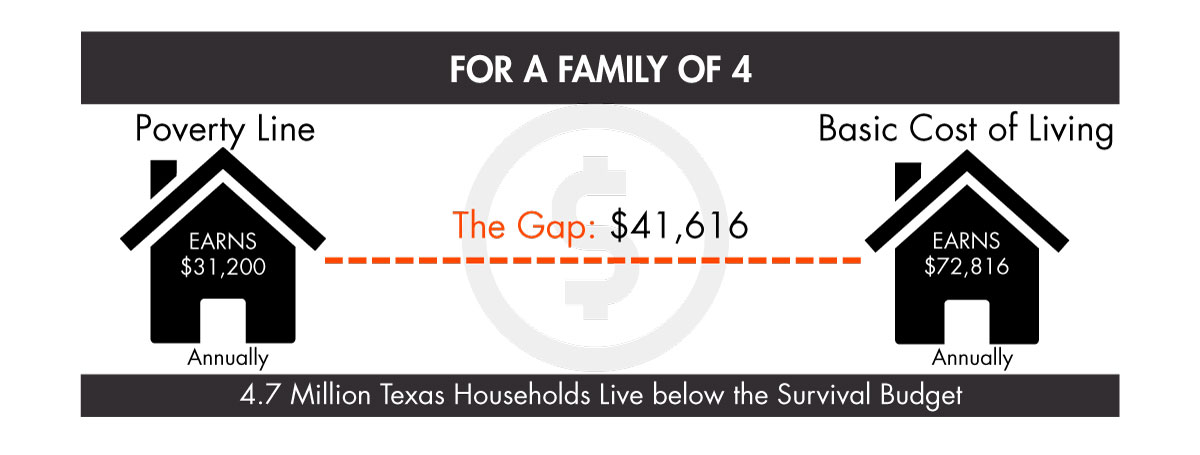
More than half of food-insecure families work full time, and 28% of working Americans, while not counted as “poor” by federal standards, still face difficult choices between basic needs.
In Texas, recent wage increases haven’t kept up with the rising costs of living, leaving many workers — home health aides ($10.20/hr), cooks ($13/hr), waiters ($10.38/hr), retail sales workers ($11/hr), cashiers (12.39/hr) and construction workers ($16/hr) — earning barely enough to get by.
A large (and growing) number of Texans working these jobs face unpredictable schedules, fluctuating incomes, and lack access to paid leave, healthcare, and childcare.
Steady Paychecks Make Food Security Possible
Our Neighbor’s Voice
“My job is not increasing my hours. I don’t have enough money to pay for food. My rent is too high. Before I had the hours at work, but now I don’t get enough to help me assist my family.”
Income Instability
In the United States, nearly 40% of households cannot cover a $400 expense. One unexpected cost – a car repair, medical emergency, or busted pipe can lead them to a financial crisis.
This instability isn’t an individual problem; it impacts the broader economy. Financially stable workers — pay rent on time, shop at local businesses, and foster economic growth. Conversely, the chaos of perpetual income instability drives food insecurity and weakens local economies.
Policy Roadmap
Sources
U.S. Department of Health and Human Services. (2024). Poverty Guidelines. https://aspe.hhs.gov/topics/poverty-economic-mobility/poverty-guidelines
- United For ALICE. (2024). ALICE in the Crosscurrents: An Update on Financial Hardship in Texas. https://www.unitedforalice.org/state-overview/texas
- USDA Economic Research Service. (2019). Food insecurity varies by adult employment status. https://www.ers.usda.gov/data-products/chart-gallery/gallery/chart-detail/?chartId=91364
- Federal Reserve Board. (2023). Economic well-being of U.S. households. https://www.federalreserve.gov/publications/files/2023-report-economic-well-being-us-households-202405.pdf
- United For ALICE. (2024). ALICE in the Crosscurrents: An Update on Financial Hardship in Texas. https://www.unitedforalice.org/state-overview/texas
- Oxfam America.(2024). Low Wages in the US: Who Makes Less Than $17 Per Hour? https://www.oxfamamerica.org/explore/countries/united-states/poverty-in-the-us/low-wage-2024/
- Manno, M. (2024). Texas is among states with highest percentage of low-wage workers, study says. San Antonio Express-News.https://www.expressnews.com/news/article/texas-among-states-low-wage-workers-19602478.php
- Leete, L., & Bania, N. (2010). The effect of income shocks on food insufficiency. Review of Economics of the Household, 8(4), 505–526.
- Hill, H. D., Romich, J., Mattingly, M. J., Shamsuddin, S., & Wething, H. (2017). An introduction to household economic instability and social policy.Social Service Review, 91(3), 371–389. https://doi.org/10.1086/694110
- Lee, C. Y., Zhao, X., Reesor-Oyer, L., Cepni, A. B., & Hernandez, D. C. (2021). Bidirectional relationship between food insecurity and housinginstability. Journal of the Academy of Nutrition and Dietetics, 121(1), 84-91. https://doi.org/10.1016/j.jand.2020.08.081
- Desmond, M., & Kimbro, R. T. (2015). Eviction’s fallout: Housing, hardship, and health.https://scholar.harvard.edu/files/mdesmond/files/desmondkimbro.evictions.fallout.sf2015_2.pdf
- Collinson, R., Reed, D., & Desmond, M. (2024). Eviction and poverty in American cities. The Quarterly Journal of Economics, 139(1), 57–120. https://doi.org/10.1093/qje/qjad042
- Aron, L., Dubay, L., Simon, S. M., Zimmerman, E., & Luk, K. X. (2015). How Are Income and Wealth Linked to Health and Longevity? Urban Institute& VCU Center on Society and Health.
- Kronstadt, J. (2008). Health and Economic Mobility. Urban Institute, The Pew Charitable Trusts. https://www.urban.org/sites/default/files/publication/31181/1001161-health-and-economic-mobility.pdf
- Khullar, D., & Chokshi, D. A. (2018). Health, Income, & Poverty: Where We Are & What Could Help. Health Affairs. https://doi.org/10.1377/hpb20180817.901935
- Fletcher, C. N., Garasky, S. B., Jensen, H. H., & Nielsen, R. B. (2010). Transportation access: A key employment barrier for rural low-incomefamilies. Journal of Family and Economic Issues, 31(2), 123-144. https://doi.org/10.1080/10875541003711581
- Kaufman, S. M., Moss, M. L., Hernandez, J., & Tyndall, J. (November). Mobility, Economic Opportunity and New York City Neighborhoods. RudinCenter for Transportation, NYU Wagner School. https://www.nyurudincenter.com
- Chetty, R., & Hendren, N. (2018). The Impacts of Neighborhoods on Intergenerational Mobility II: County-Level Estimates. Quarterly Journal ofEconomics, 133(3), 1163-1228. https://doi.org/10.1093/qje/qjy006
- Kofron, K., & Meier, J. (2024). Access to affordable high-quality child care is scarce. Children at Risk. https://childrenatrisk.org/child-care-desert-analysis-2024/
- Federal Reserve Bank of Atlanta. (n.d.). Economic Mobility and Resilience: Everyone’s Economy. https://www.atlantafed.org/economic-mobility-and-resilience/everyones-economy/advancing-careers-for-low-income-families/what-are-benefits-cliffs
- Board of Governors of the Federal Reserve System. (2019). Report on the economic well-being of U.S. households in 2018. https://www.federalreserve.gov/publications/files/2018-report-economic-well-being-us-households-201905.pdf
- Coleman-Jensen A., & Nord, M. (2013). Food insecurity among households with working-age adults with disabilities. U.S. Department of Agriculture,Economic Research Service: Washington, D.C.
- Balistreri, K.S. (2018). Family structure and child food insecurity: evidence from the current population survey. Social Indicators Research, 138(3),1171-1185.
- Cook, J.T., Frank, D.A., Levenson, S.M., Neault, N.B., Heeren, T.C., Black, M.M., … & Chilton, M. (2006). Child food insecurity increases risks posedby household food insecurity to young children’s health. The Journal of Nutrition 136(4), 1073-1076.
- Gundersen, C., & Ziliak, J.P. (2015). Food insecurity and health outcomes. Health Affairs, 34(11), 1830-1839.
- Rabbitt, Matthew P. and Michael D. Smith May (2021). Food Insecurity Among Working-Age
- Veterans, ERR-829, U.S. Department of Agriculture, Economic Research Service.